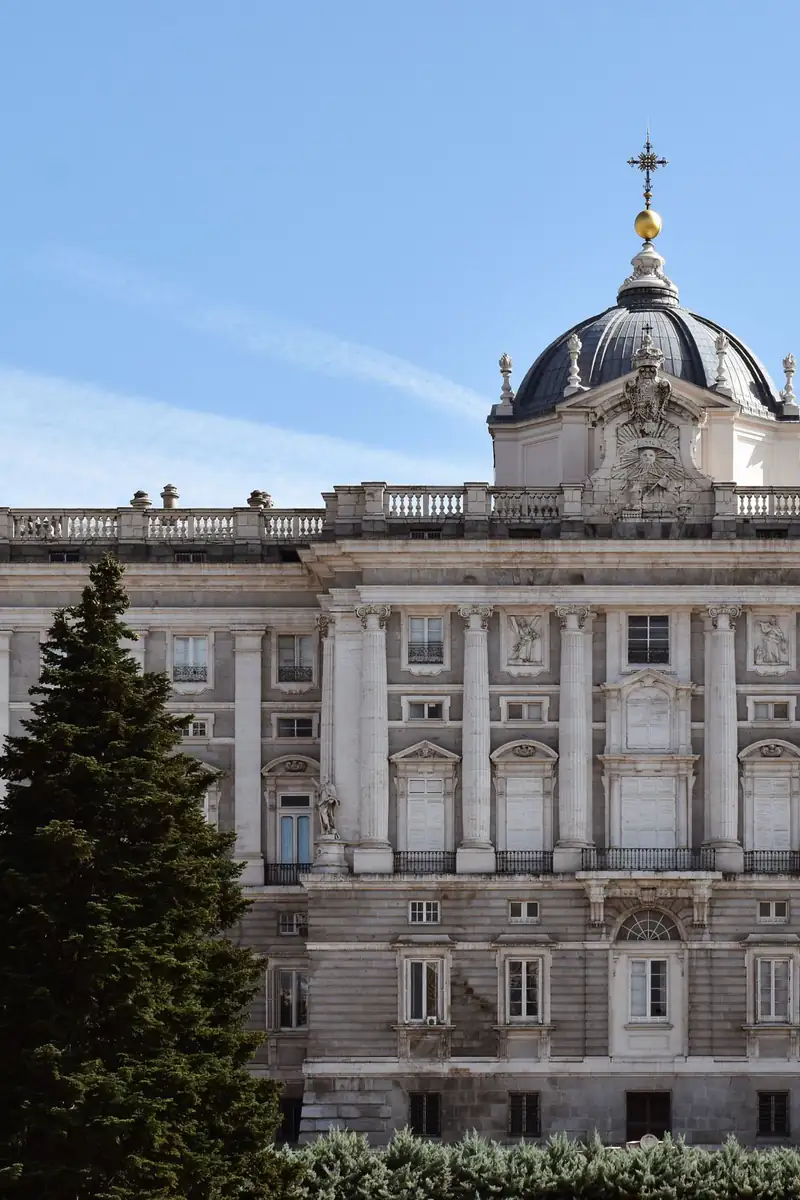
The Palacio Real de Madrid — the vast white limestone south facade above Plaza de la Armería, with the Almudena Cathedral domes to the right under a clear Castilian sky.

Europe's largest royal palace

The Palacio Real de Madrid — 3,418 rooms of Bourbon state grandeur above the old Alcázar, still used for the Crown's ceremonies. Your timed-entry slot skips the ticket-counter queue that builds on Plaza de la Armería by mid-morning.

See ticket options
  • 3,418 rooms Europe's largest functioning royal palace by floor area
  • 1738–1755 Built for the Bourbons on the site of the old Alcázar
  • Tiepolo ceilings The Throne Room vault frescoed by Giambattista Tiepolo
  • Real Armería One of the world's finest royal armouries

Choose your ticket

Adult — Skip-the-line Entry

Live availability

Ages 25+ — self-guided visit, audio guide optional

€35

  • Skip-the-line entry to the Royal Palace of Madrid
  • State Rooms, Throne Room, Royal Armoury & Gallery of Royal Collections
  • Your timed slot, secured before the daily cap fills
  • Mobile ticket — no printing needed
Notify me when bookings open

Reduced (under 25 & 65+)

Live availability

Under 25 or 65+ — photo ID required at the gate

€28

  • Same access as the Adult ticket
  • Skip-the-line entry to the State Rooms and Royal Armoury
  • Bring photo ID showing age — the operator denies the reduced rate without it
  • Children under 5 walk in free at the gate — no ticket needed
Notify me when bookings open
  • Refund if we can't deliver
  • Cards & Apple Pay
  • Instant confirmation
  • Concierge in your language, 24/7

5-minute audio guide

Your Royal Palace of Madrid 5-minute guide

Hand-written, narrated by a heritage host. Five minutes inside the Bourbons' great palace — the Tiepolo throne room, the armour of Charles V, and the staircase Napoleon's brother climbed as king.

  • Why the Bourbons built over the burned Habsburg Alcázar
  • Tiepolo's Apotheosis of the Spanish Monarchy in the Throne Room
  • The parade armour of Charles V in the Royal Armoury
  • The Palatine Stradivarius — the decorated royal string quartet

Included free with every ticket. No app, no download — plays in any browser.

About Royal Palace of Madrid

The Palacio Real de Madrid is the official residence of the Spanish Crown and, at roughly 135,000 square metres of floor area and some 3,418 rooms, the largest functioning royal palace in Europe. The Spanish royal family does not live here — they reside at the smaller Palacio de la Zarzuela on the city's outskirts — but the palace is still used for state ceremonies, royal audiences and official banquets, and large parts of it are open to the public as a historic-art museum.

The palace stands on the site of the old Alcázar of Madrid, the Habsburg fortress-palace that burned to the ground on Christmas Eve 1734. Philip V, the first Bourbon king of Spain, ordered a new palace in the modern French-Italian taste. The Sicilian architect Filippo Juvarra drew the first grand design before his death in 1736; his pupil Giovanni Battista Sacchetti realised the built palace between 1738 and 1755, and Francesco Sabatini later added wings and the monumental staircase. Charles III became the first monarch to take up residence, in 1764.

The state apartments are a catalogue of eighteenth-century court art. The Grand Staircase by Sabatini rises beneath a ceiling fresco by Corrado Giaquinto. The Throne Room (Salón del Trono) keeps its original 1760s decoration intact, crowned by Giambattista Tiepolo's ceiling fresco The Apotheosis of the Spanish Monarchy (1764) and lined with crimson velvet, rock-crystal chandeliers from Venice and bronze lions. The Gasparini Room, the Hall of Mirrors, the Royal Chapel and the Porcelain Room each preserve a complete period interior; the walls carry works by Caravaggio, Velázquez, Goya, Tiepolo and Mengs.

Two collections within the palace are world-class in their own right. The Royal Armoury (Real Armería) holds one of the finest collections of arms and armour in the world, including the parade and battle armour of Charles V and Philip II. The Royal Pharmacy (Real Farmacia) preserves a complete court apothecary of jars, stills and recipe books. The palace also keeps the 'Palatine' Stradivarius — a rare decorated set of string instruments by Antonio Stradivari, assembled for the Spanish court and still occasionally played.
Practical information

Address
Calle de Bailén, s/n, 28071 Madrid, Spain
Getting there
Metro to Ópera (lines 2, 5 and the Ramal) is the closest station, a 3-minute walk to the entrance on Plaza de la Armería. City buses 3, 39 and 148 stop nearby. From Puerta del Sol it is a 12-minute walk west through the old centre. There is no dedicated visitor car park; use public garages around Plaza de Oriente or Plaza de España.
Time needed
Open daily; occasionally closed at short notice for official ceremonies. Plan 75–120 minutes for the standard self-guided route through the State Rooms and the Royal Armoury. Art-history visitors who add the Royal Kitchen and the painting galleries typically spend 2.5 hours.
What to wear
No specific dress code, though the Royal Chapel is a consecrated space. Comfortable walking shoes for the long marble corridors and the staircase. Central Madrid is hot in July and August and cold in winter — dress for the street, as the queue on Plaza de la Armería is open-air.
Accessibility
Lifts and an accessible route cover most of the State Rooms; staff at the entrance provide the accessible-route map and can advise on the few stepped thresholds. Accessible toilets are signposted from the main entrance.

About our service

Royal Palace Madrid Tickets acts as a facilitator to assist international visitors in purchasing skip-the-line tickets directly from the official operator of the Royal Sites of Spain. We do not resell tickets — we provide a personalised booking and English-language support service. Our concierge service fee is included in the displayed price. For those who prefer to purchase directly, the official ticket site is tickets.patrimonionacional.es. EU citizens, EU residents and Ibero-American citizens are entitled to free entry during certain late-afternoon windows; those free passes are issued only on the day at the on-site ticket office on a first-come basis and cannot be reserved online.

Frequently asked

Where is the Royal Palace and how do I get there?

The Palacio Real is on Calle de Bailén in central Madrid, beside the Almudena Cathedral and Plaza de Oriente. The closest Metro station is Ópera (lines 2, 5 and the Ramal), a 3-minute walk to the entrance on Plaza de la Armería. From Puerta del Sol it is a 12-minute walk. City buses 3, 39 and 148 stop nearby. There is no dedicated visitor car park; use the public garages around Plaza de Oriente or Plaza de España.

What are the opening hours?

The palace is open every day. In summer (April–September) it opens Monday to Saturday 10:00–19:00 and Sunday 10:00–16:00; in winter (October–March) Monday to Saturday 10:00–18:00 and Sunday 10:00–16:00, with last admission about an hour before closing. It is closed on 1 and 6 January, 1 May and 25 December, and occasionally at short notice for official state ceremonies, royal audiences or banquets — these are the main reason a particular date can become unavailable, so we confirm availability before issuing your ticket.

How long does a visit take?

Plan 75–120 minutes for the standard self-guided route through the Grand Staircase, the State Rooms and the Royal Armoury. Visitors who add the Royal Kitchen, the Royal Pharmacy and the painting galleries typically spend around 2.5 hours.

What's included in the ticket?

The standard ticket covers the public route of the palace: the Grand Staircase, the Hall of Columns, the State Rooms (including the Throne Room, the Gasparini Room and the Hall of Mirrors), the Royal Chapel, the painting galleries and the Royal Armoury — plus the Gallery of Royal Collections, the major museum that opened beside the palace in 2023. The Royal Kitchen and any temporary exhibitions are sometimes sold as separate add-ons; the gardens (Sabatini Gardens and Campo del Moro) are free public parks.

Is entry free at certain times — can I just turn up?

Free entry exists for EU citizens, EU residents and Ibero-American citizens during certain late-afternoon windows on weekdays. The free passes are issued only at the on-site ticket office on the day, on a first-come basis, and cannot be reserved online. They have a daily cap that often sells out before the window opens, and the queue can be long. Non-EU visitors (US, UK, Canada, Australia, Japan, China, etc.) do not qualify and should book the normal timed ticket. Our skip-the-line ticket is the only way to guarantee a specific entry time.

Can I see the Changing of the Guard?

Yes. A relief of the guard takes place at the palace on Wednesdays and Saturdays (outside July, August, September and on ceremony days), and a larger Solemn Changing of the Guard is held on the first Wednesday of most months. Both happen outdoors at the Puerta del Príncipe and are free to watch from Plaza de la Armería — no ticket needed. If you want to combine the spectacle with your visit, book a palace slot for after it finishes, as the plaza and the entrance queue are at their busiest on guard mornings.

What's restricted inside?

Photography without flash is generally permitted in the State Rooms, but it is prohibited in the Royal Armoury and in some temporary-exhibition galleries; signage and staff indicate where. Large bags and backpacks must be left in the entrance cloakroom. Selfie sticks and tripods are not allowed inside. The Royal Chapel is a consecrated space.

Is there an audio guide?

Yes — the operator sells a multilingual audio guide at the entrance for a small additional fee. Languages usually include Spanish, English, French, German, Italian, Portuguese, Japanese and Chinese. The audio guide runs roughly 60–90 minutes for the full State-Rooms route.

Is it accessible for wheelchair users?

Most of the public State-Rooms route is accessible via lifts and an adapted itinerary; a few stepped thresholds remain. Staff at the entrance provide the accessible-route map and can advise on the best path. Accessible toilets are signposted from the main entrance.

Can I combine the Royal Palace with El Escorial or Aranjuez?

Yes — all three are run by the same official operator, so the ticketing and QR-scanning work the same way. A common itinerary is El Escorial or Aranjuez in the morning (both are short train rides from Madrid) and the Royal Palace in the late afternoon. Allow time for the transfer; book a late-afternoon palace slot so an earlier site over-running doesn't cost you the entry.

Where can I eat nearby?

The streets around Plaza de Oriente and Ópera are full of cafés and restaurants; the Plaza de Oriente terraces face the palace. For something more local, the Mercado de San Miguel and the bars around Plaza Mayor are a 10-minute walk east. The Café de Oriente is the classic grand café directly opposite the palace gardens.

When is the best time of year to visit?

Spring (April–June) and autumn (mid-September–October) offer the most comfortable weather and slightly lighter crowds than high summer. July and August are hot in Madrid but the palace interior is cool. Winter is the quietest period and the State Rooms are at their most atmospheric. Whatever the season, the first hour after opening and the last 90 minutes before closing are the calmest windows of the day.

What is the Throne Room and why is it famous?

The Salón del Trono keeps its original 1760s decoration completely intact — one of the few European throne rooms to do so. The walls are hung with crimson velvet, the chandeliers are Venetian rock crystal, and bronze lions flank the twin thrones. The ceiling carries Giambattista Tiepolo's fresco The Apotheosis of the Spanish Monarchy, painted in 1764, one of the last great works of the Venetian master. It is the single most-photographed room on the route.

What is the Royal Armoury?

The Real Armería is one of the finest collections of arms and armour in the world, built up by the Habsburg and Bourbon kings. Its centrepieces are the parade and battle armours of Emperor Charles V and his son Philip II, several of them shown on full-size horse-and-rider mannequins. It occupies a separate building off the main courtyard and is included in the standard ticket. Photography is not permitted inside the Armoury.

Are children free?

Children under 5 are admitted free at the gate, accompanied by a paying adult — no separate ticket needed. Under-25s and visitors aged 65+ qualify for the reduced rate on presentation of photo ID showing age.

What is your cancellation and refund policy?

Tickets are issued for a specific date and time slot. All sales are final — we are unable to offer customer-initiated refunds or rebookings once the operator has issued the ticket. The only refund cases are operator-side failures (an unscheduled closure for a state ceremony on your date, a strike, or similar) in which we contact every affected customer and refund in full when no equivalent slot is available within your trip dates.

Where can I take photographs?

Photography without flash is generally allowed in the State Rooms and is the rule that most visitors care about for the Throne Room and the Gasparini Room. It is prohibited in the Royal Armoury and in certain temporary exhibitions. Tripods and selfie sticks are not allowed inside. The exterior — Plaza de la Armería, the south facade and the views from Plaza de Oriente and the Sabatini Gardens — is freely photographable.